Source page 82
Read the text of this page
Annex 3
to the Road Rules
ROAD MARKINGS AND THEIR CHARACTERISTICS
The title of the annex changed:
No 273, 19/04/2023, published in the RLA on 20/04/2023, ID code 2023-07672
CHAPTER I
HORIZONTAL MARKING
1. Horizontal markings (lines, arrows, inscriptions and other symbols on the
carriageway in white or in other colours as defined in this Chapter) shall determine the traffic
regime and order:
Amendments to the Paragraph:
No 273, 19/04/2023, published in the RLA on 20/04/2023, ID code 2023-07672
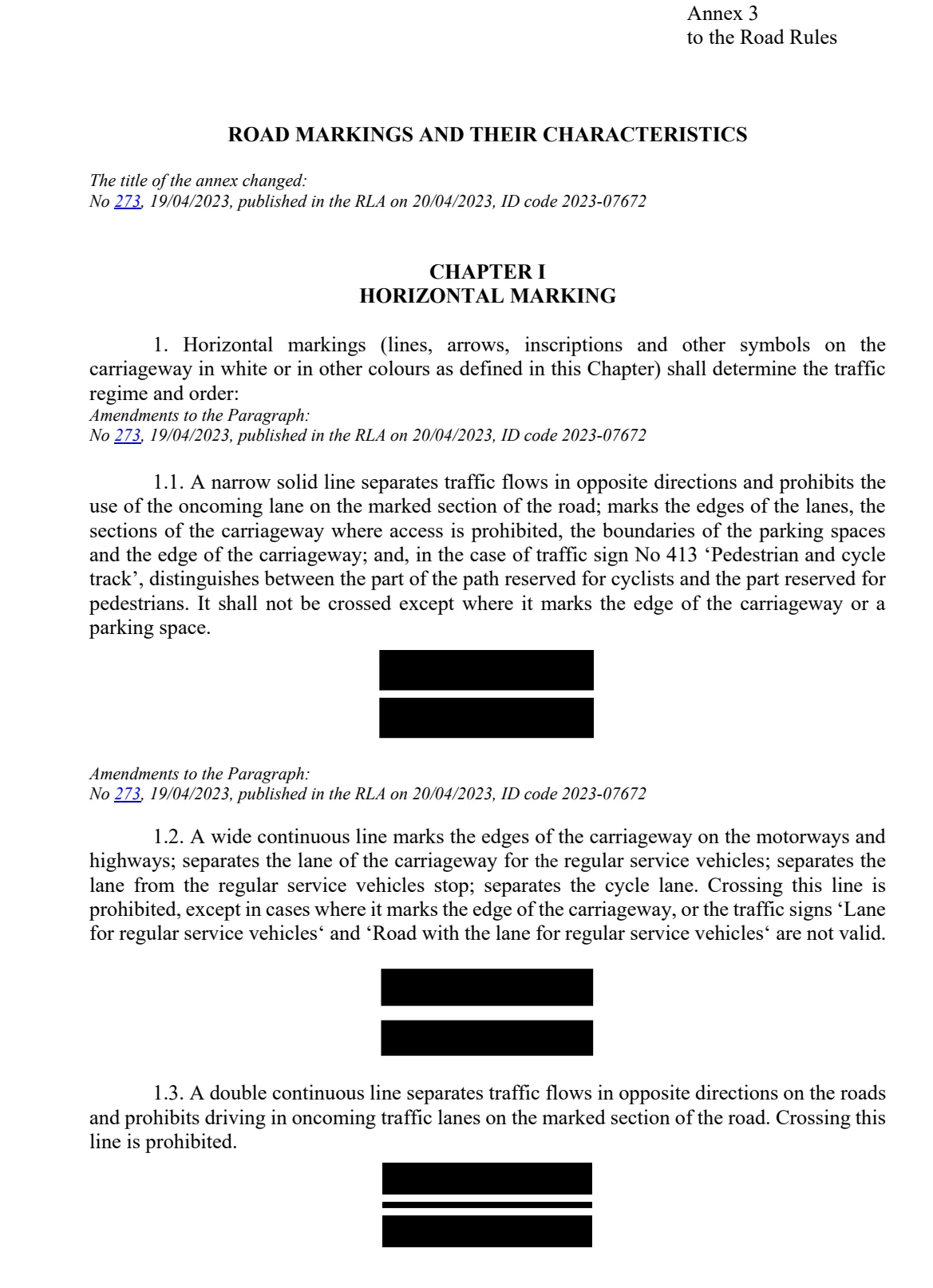
1.1. A narrow solid line separates traffic flows in opposite directions and prohibits the
use of the oncoming lane on the marked section of the road; marks the edges of the lanes, the
sections of the carriageway where access is prohibited, the boundaries of the parking spaces
and the edge of the carriageway; and, in the case of traffic sign No 413 ‘Pedestrian and cycle
track’, distinguishes between the part of the path reserved for cyclists and the part reserved for
pedestrians. It shall not be crossed except where it marks the edge of the carriageway or a
parking space.
Amendments to the Paragraph:
No 273, 19/04/2023, published in the RLA on 20/04/2023, ID code 2023-07672
1.2. A wide continuous line marks the edges of the carriageway on the motorways and
highways; separates the lane of the carriageway for the regular service vehicles; separates the
lane from the regular service vehicles stop; separates the cycle lane. Crossing this line is
prohibited, except in cases where it marks the edge of the carriageway, or the traffic signs ‘Lane
for regular service vehicles‘ and ‘Road with the lane for regular service vehicles‘ are not valid.
1.3. A double continuous line separates traffic flows in opposite directions on the roads
and prohibits driving in oncoming traffic lanes on the marked section of the road. Crossing this
line is prohibited.
Source page 83
Read the text of this page
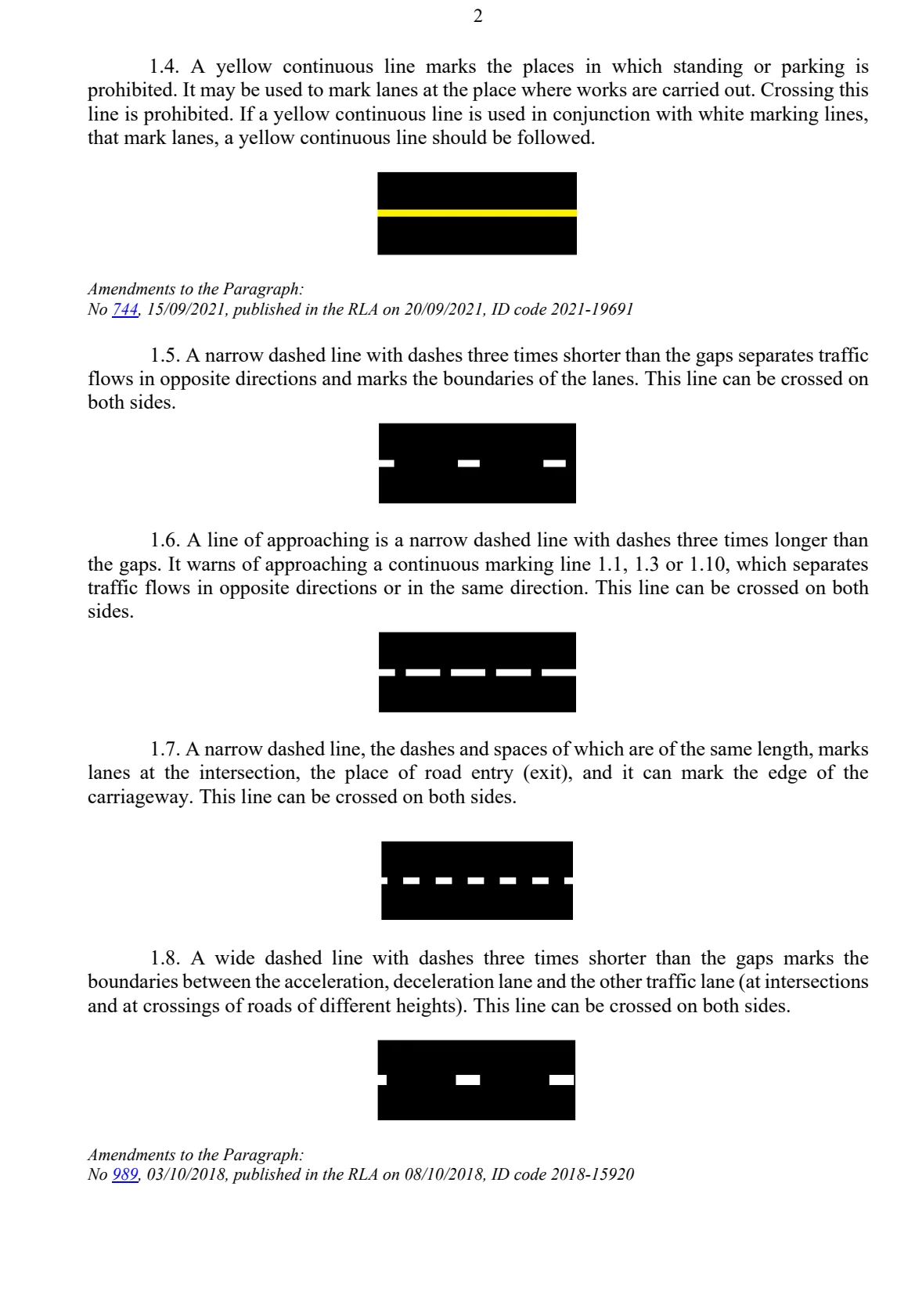
1.4. A yellow continuous line marks the places in which standing or parking is
prohibited. It may be used to mark lanes at the place where works are carried out. Crossing this
line is prohibited. If a yellow continuous line is used in conjunction with white marking lines,
that mark lanes, a yellow continuous line should be followed.
Amendments to the Paragraph:
No 744, 15/09/2021, published in the RLA on 20/09/2021, ID code 2021-19691
1.5. A narrow dashed line with dashes three times shorter than the gaps separates traffic
flows in opposite directions and marks the boundaries of the lanes. This line can be crossed on
both sides.
1.6. A line of approaching is a narrow dashed line with dashes three times longer than
the gaps. It warns of approaching a continuous marking line 1.1, 1.3 or 1.10, which separates
traffic flows in opposite directions or in the same direction. This line can be crossed on both
sides.
1.7. A narrow dashed line, the dashes and spaces of which are of the same length, marks
lanes at the intersection, the place of road entry (exit), and it can mark the edge of the
carriageway. This line can be crossed on both sides.
1.8. A wide dashed line with dashes three times shorter than the gaps marks the
boundaries between the acceleration, deceleration lane and the other traffic lane (at intersections
and at crossings of roads of different heights). This line can be crossed on both sides.
Amendments to the Paragraph:
No 989, 03/10/2018, published in the RLA on 08/10/2018, ID code 2018-15920
Source page 84
Read the text of this page
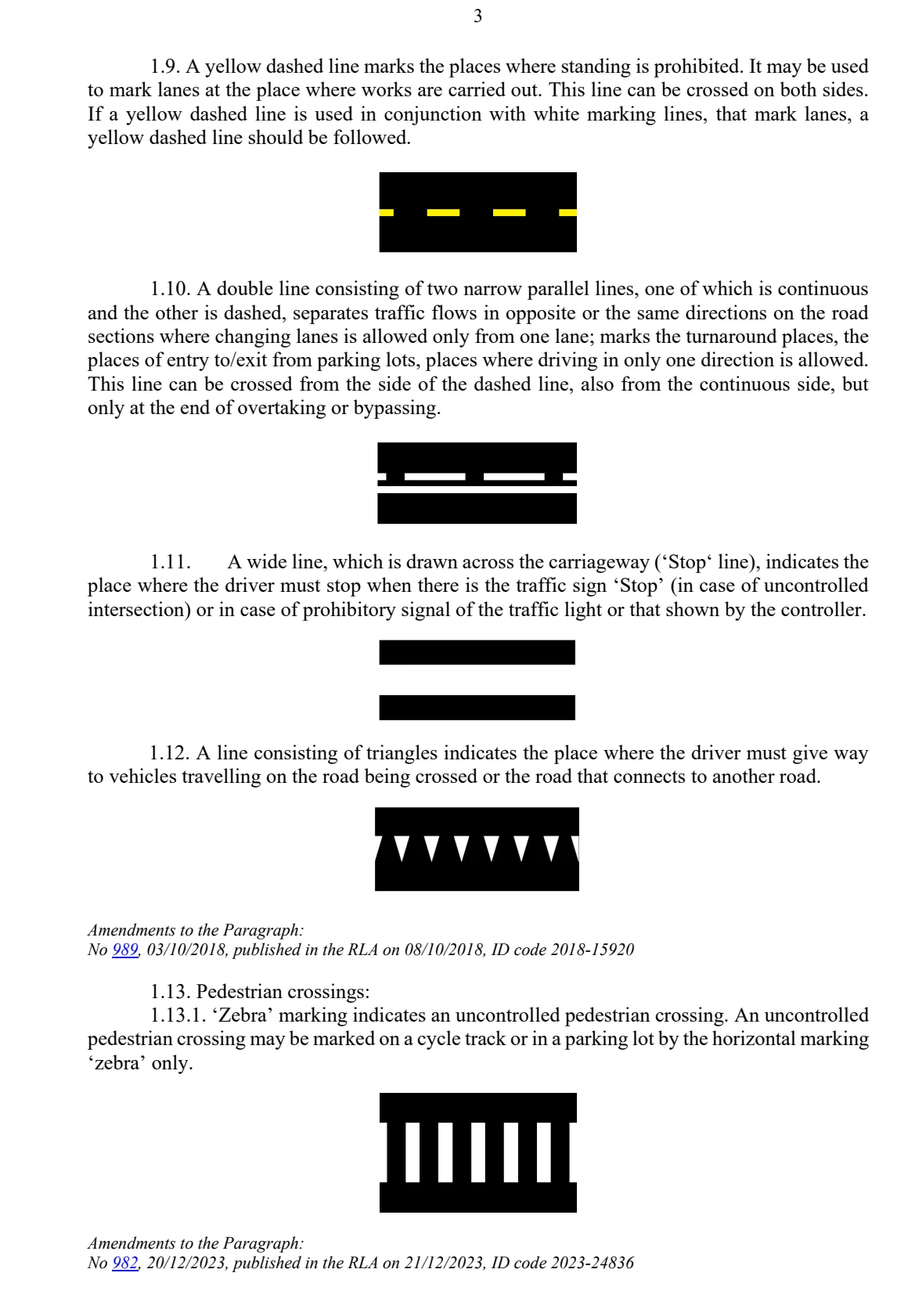
1.9. A yellow dashed line marks the places where standing is prohibited. It may be used
to mark lanes at the place where works are carried out. This line can be crossed on both sides.
If a yellow dashed line is used in conjunction with white marking lines, that mark lanes, a
yellow dashed line should be followed.
1.10. A double line consisting of two narrow parallel lines, one of which is continuous
and the other is dashed, separates traffic flows in opposite or the same directions on the road
sections where changing lanes is allowed only from one lane; marks the turnaround places, the
places of entry to/exit from parking lots, places where driving in only one direction is allowed.
This line can be crossed from the side of the dashed line, also from the continuous side, but
only at the end of overtaking or bypassing.
1.11. A wide line, which is drawn across the carriageway (‘Stop‘ line), indicates the
place where the driver must stop when there is the traffic sign ‘Stop’ (in case of uncontrolled
intersection) or in case of prohibitory signal of the traffic light or that shown by the controller.
1.12. A line consisting of triangles indicates the place where the driver must give way
to vehicles travelling on the road being crossed or the road that connects to another road.
Amendments to the Paragraph:
No 989, 03/10/2018, published in the RLA on 08/10/2018, ID code 2018-15920
1.13. Pedestrian crossings:
1.13.1. ‘Zebra’ marking indicates an uncontrolled pedestrian crossing. An uncontrolled
pedestrian crossing may be marked on a cycle track or in a parking lot by the horizontal marking
‘zebra’ only.
Amendments to the Paragraph:
No 982, 20/12/2023, published in the RLA on 21/12/2023, ID code 2023-24836
Source page 85
Read the text of this page
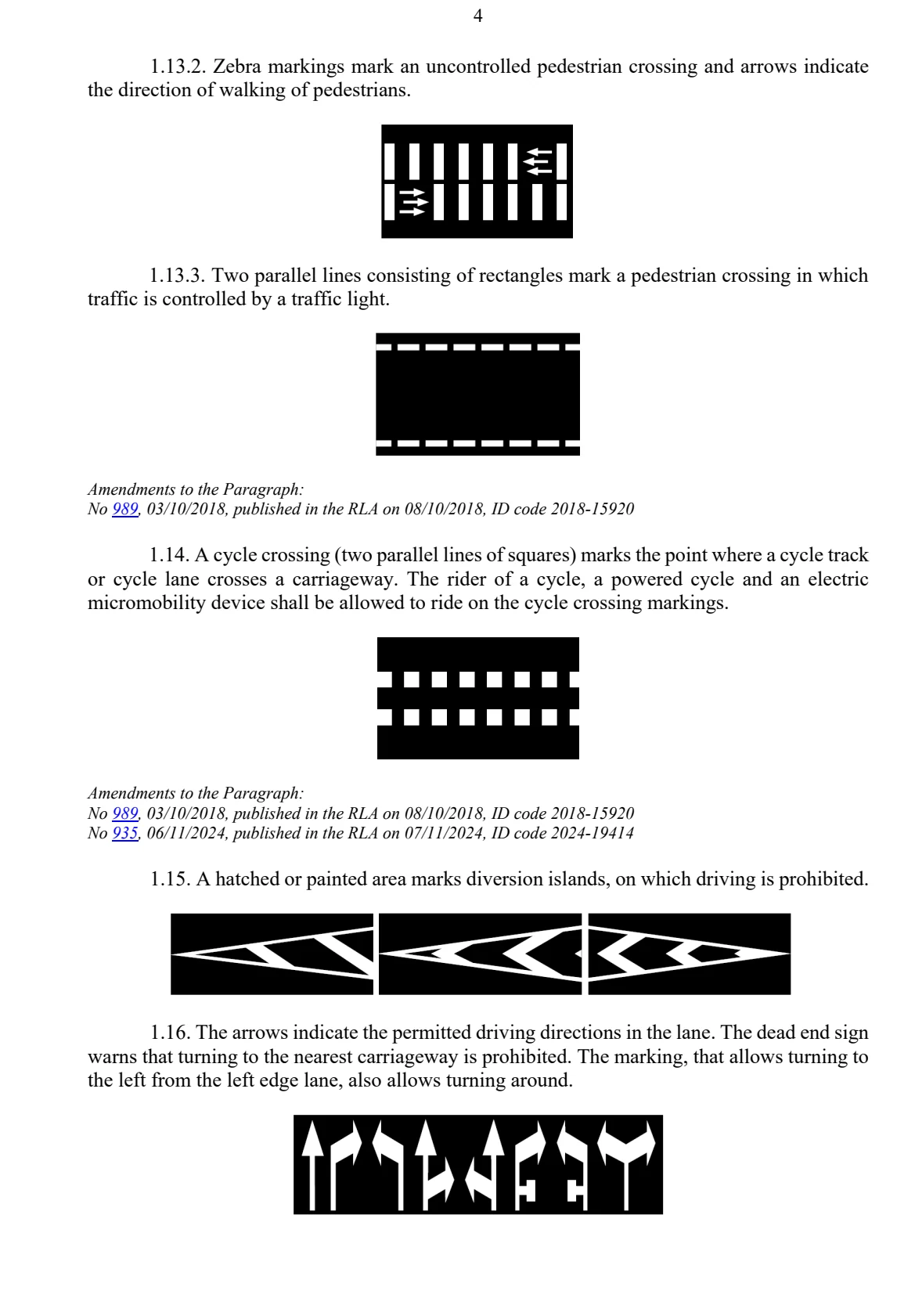
1.13.2. Zebra markings mark an uncontrolled pedestrian crossing and arrows indicate
the direction of walking of pedestrians.
1.13.3. Two parallel lines consisting of rectangles mark a pedestrian crossing in which
traffic is controlled by a traffic light.
Amendments to the Paragraph:
No 989, 03/10/2018, published in the RLA on 08/10/2018, ID code 2018-15920
1.14. A cycle crossing (two parallel lines of squares) marks the point where a cycle track
or cycle lane crosses a carriageway. The rider of a cycle, a powered cycle and an electric
micromobility device shall be allowed to ride on the cycle crossing markings.
Amendments to the Paragraph:
No 989, 03/10/2018, published in the RLA on 08/10/2018, ID code 2018-15920
No 935, 06/11/2024, published in the RLA on 07/11/2024, ID code 2024-19414
1.15. A hatched or painted area marks diversion islands, on which driving is prohibited.
1.16. The arrows indicate the permitted driving directions in the lane. The dead end sign
warns that turning to the nearest carriageway is prohibited. The marking, that allows turning to
the left from the left edge lane, also allows turning around.
Source page 86
Read the text of this page
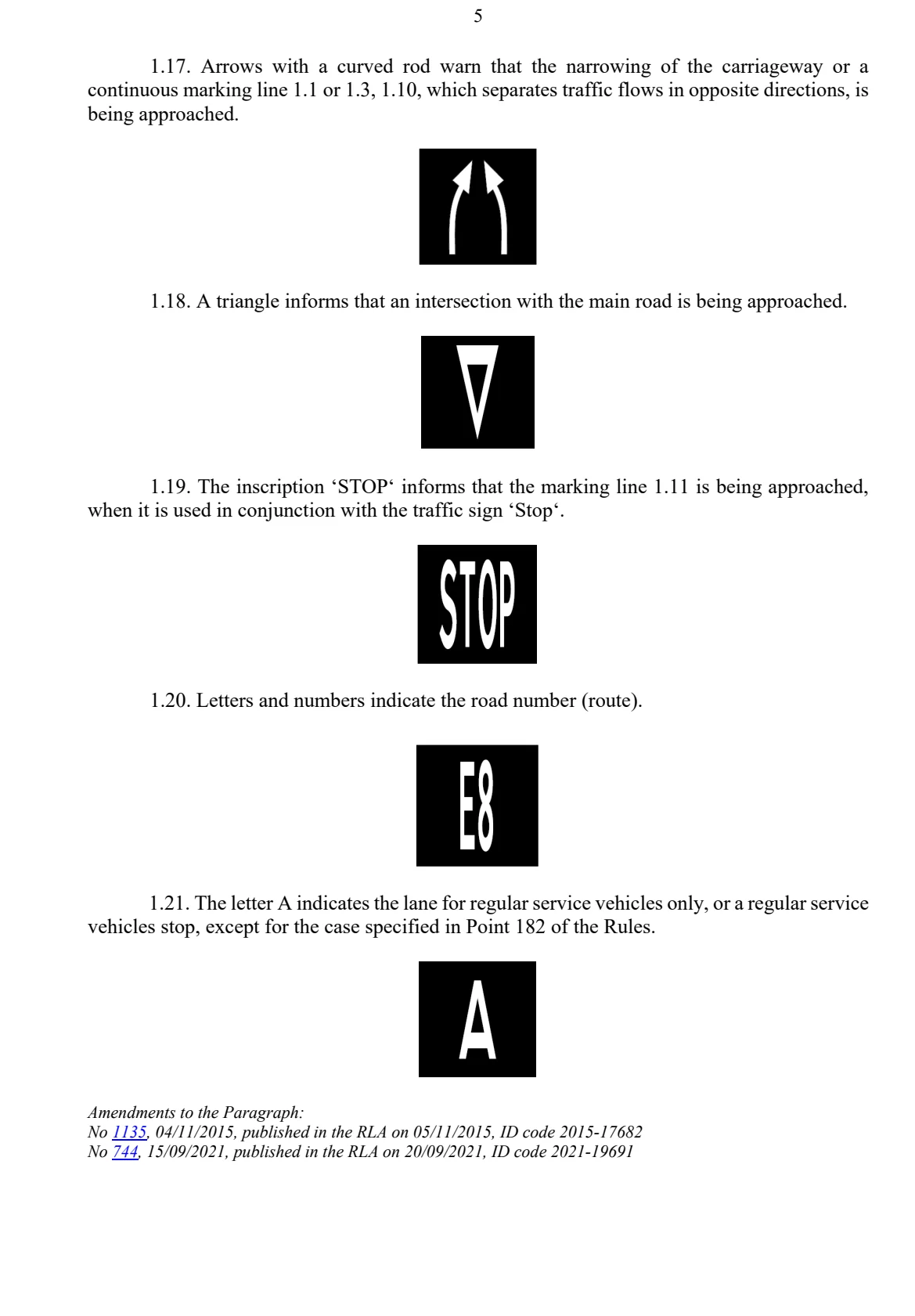
1.17. Arrows with a curved rod warn that the narrowing of the carriageway or a
continuous marking line 1.1 or 1.3, 1.10, which separates traffic flows in opposite directions, is
being approached.
1.18. A triangle informs that an intersection with the main road is being approached.
1.19. The inscription ‘STOP‘ informs that the marking line 1.11 is being approached,
when it is used in conjunction with the traffic sign ‘Stop‘.
1.20. Letters and numbers indicate the road number (route).
1.21. The letter A indicates the lane for regular service vehicles only, or a regular service
vehicles stop, except for the case specified in Point 182 of the Rules.
Amendments to the Paragraph:
No 1135, 04/11/2015, published in the RLA on 05/11/2015, ID code 2015-17682
No 744, 15/09/2021, published in the RLA on 20/09/2021, ID code 2021-19691
Source page 87
Read the text of this page
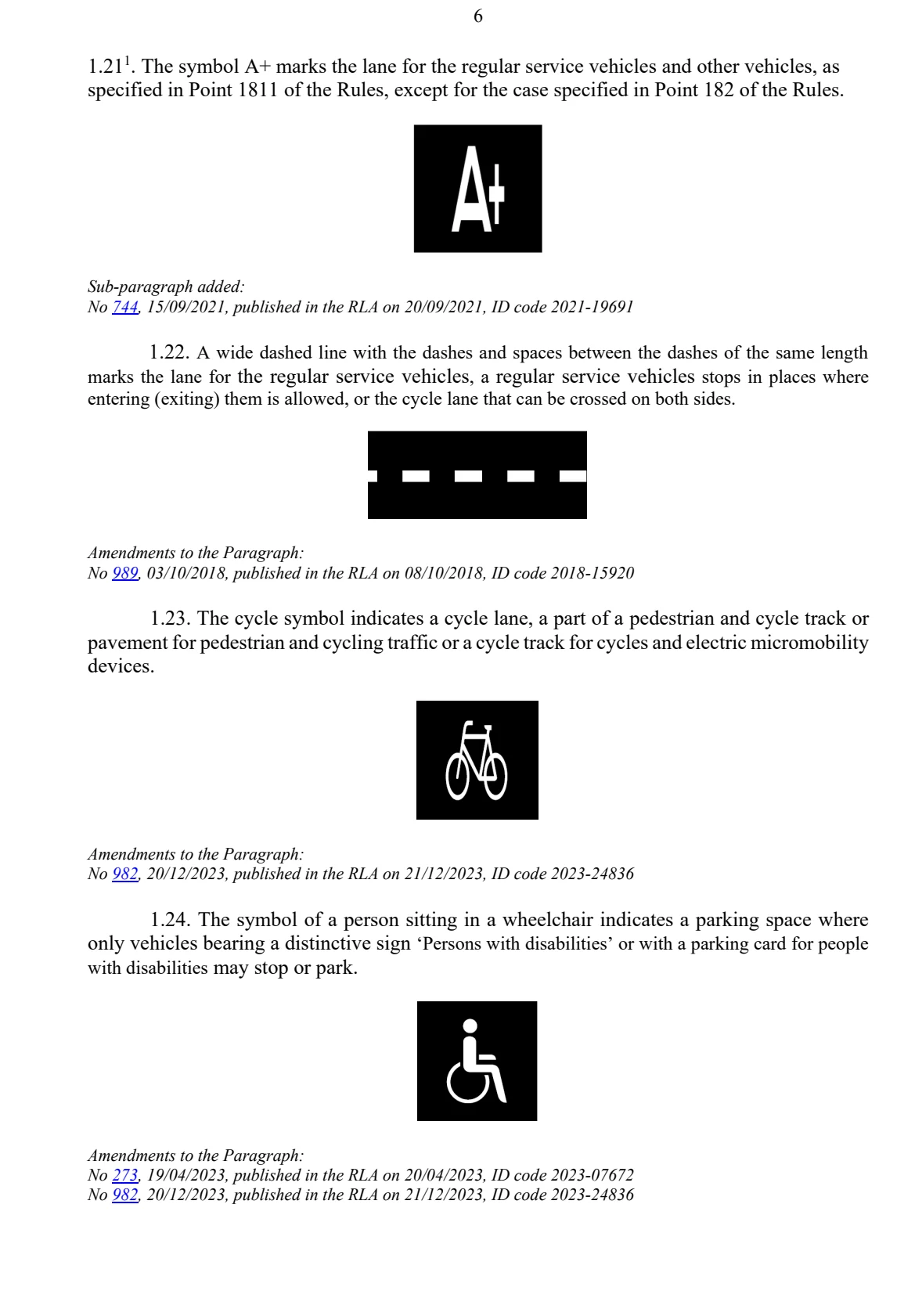
1.211. The symbol A+ marks the lane for the regular service vehicles and other vehicles, as
specified in Point 1811 of the Rules, except for the case specified in Point 182 of the Rules.
Sub-paragraph added:
No 744, 15/09/2021, published in the RLA on 20/09/2021, ID code 2021-19691
1.22. A wide dashed line with the dashes and spaces between the dashes of the same length
marks the lane for the regular service vehicles, a regular service vehicles stops in places where
entering (exiting) them is allowed, or the cycle lane that can be crossed on both sides.
Amendments to the Paragraph:
No 989, 03/10/2018, published in the RLA on 08/10/2018, ID code 2018-15920
1.23. The cycle symbol indicates a cycle lane, a part of a pedestrian and cycle track or
pavement for pedestrian and cycling traffic or a cycle track for cycles and electric micromobility
devices.
Amendments to the Paragraph:
No 982, 20/12/2023, published in the RLA on 21/12/2023, ID code 2023-24836
1.24. The symbol of a person sitting in a wheelchair indicates a parking space where
only vehicles bearing a distinctive sign ‘Persons with disabilities’ or with a parking card for people
with disabilities may stop or park.
Amendments to the Paragraph:
No 273, 19/04/2023, published in the RLA on 20/04/2023, ID code 2023-07672
No 982, 20/12/2023, published in the RLA on 21/12/2023, ID code 2023-24836
Source page 88
Read the text of this page
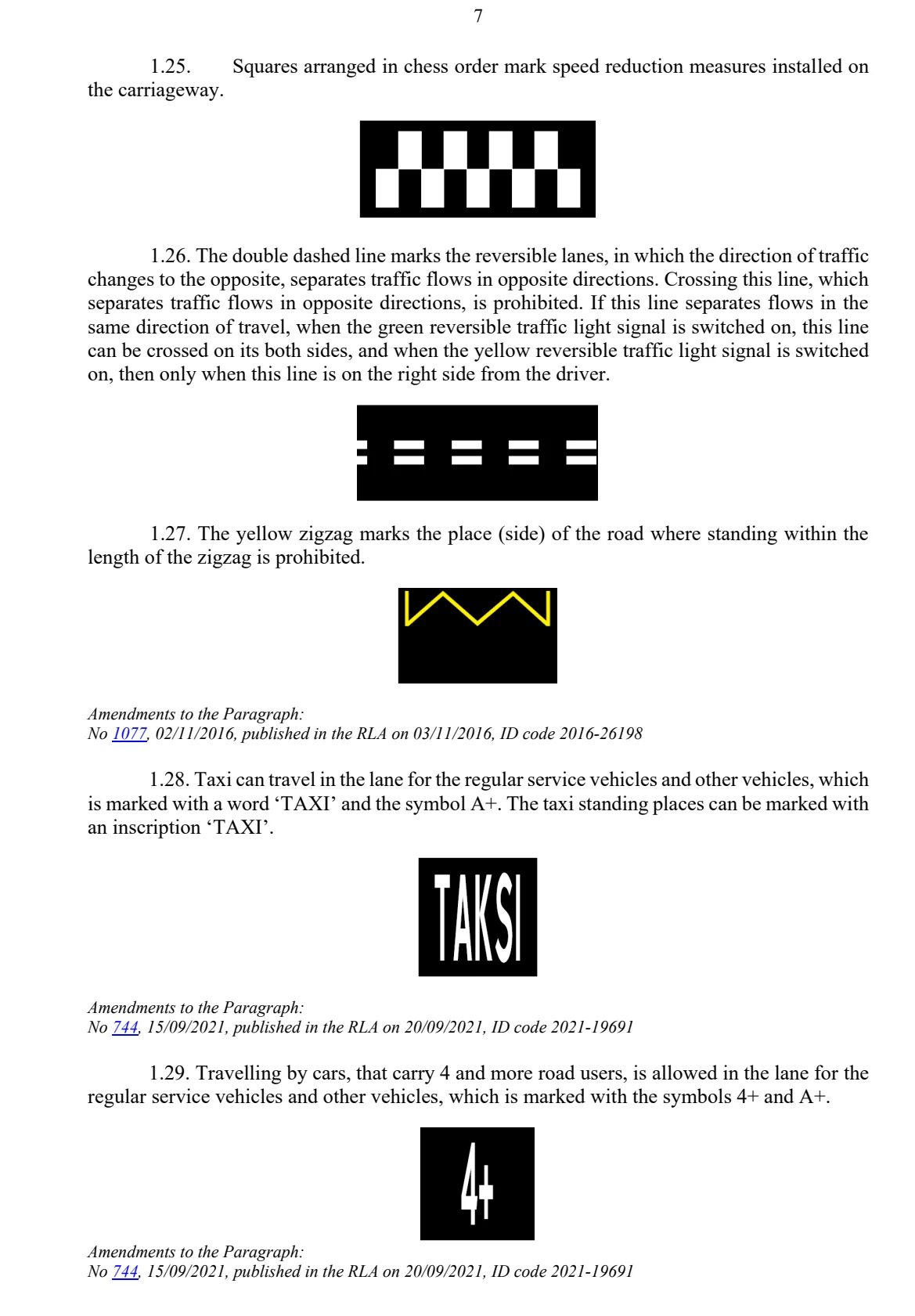
1.25. Squares arranged in chess order mark speed reduction measures installed on
the carriageway.
1.26. The double dashed line marks the reversible lanes, in which the direction of traffic
changes to the opposite, separates traffic flows in opposite directions. Crossing this line, which
separates traffic flows in opposite directions, is prohibited. If this line separates flows in the
same direction of travel, when the green reversible traffic light signal is switched on, this line
can be crossed on its both sides, and when the yellow reversible traffic light signal is switched
on, then only when this line is on the right side from the driver.
1.27. The yellow zigzag marks the place (side) of the road where standing within the
length of the zigzag is prohibited.
Amendments to the Paragraph:
No 1077, 02/11/2016, published in the RLA on 03/11/2016, ID code 2016-26198
1.28. Taxi can travel in the lane for the regular service vehicles and other vehicles, which
is marked with a word ‘TAXI’ and the symbol A+. The taxi standing places can be marked with
an inscription ‘TAXI’.
Amendments to the Paragraph:
No 744, 15/09/2021, published in the RLA on 20/09/2021, ID code 2021-19691
1.29. Travelling by cars, that carry 4 and more road users, is allowed in the lane for the
regular service vehicles and other vehicles, which is marked with the symbols 4+ and A+.
Amendments to the Paragraph:
No 744, 15/09/2021, published in the RLA on 20/09/2021, ID code 2021-19691
Source page 89
Read the text of this page
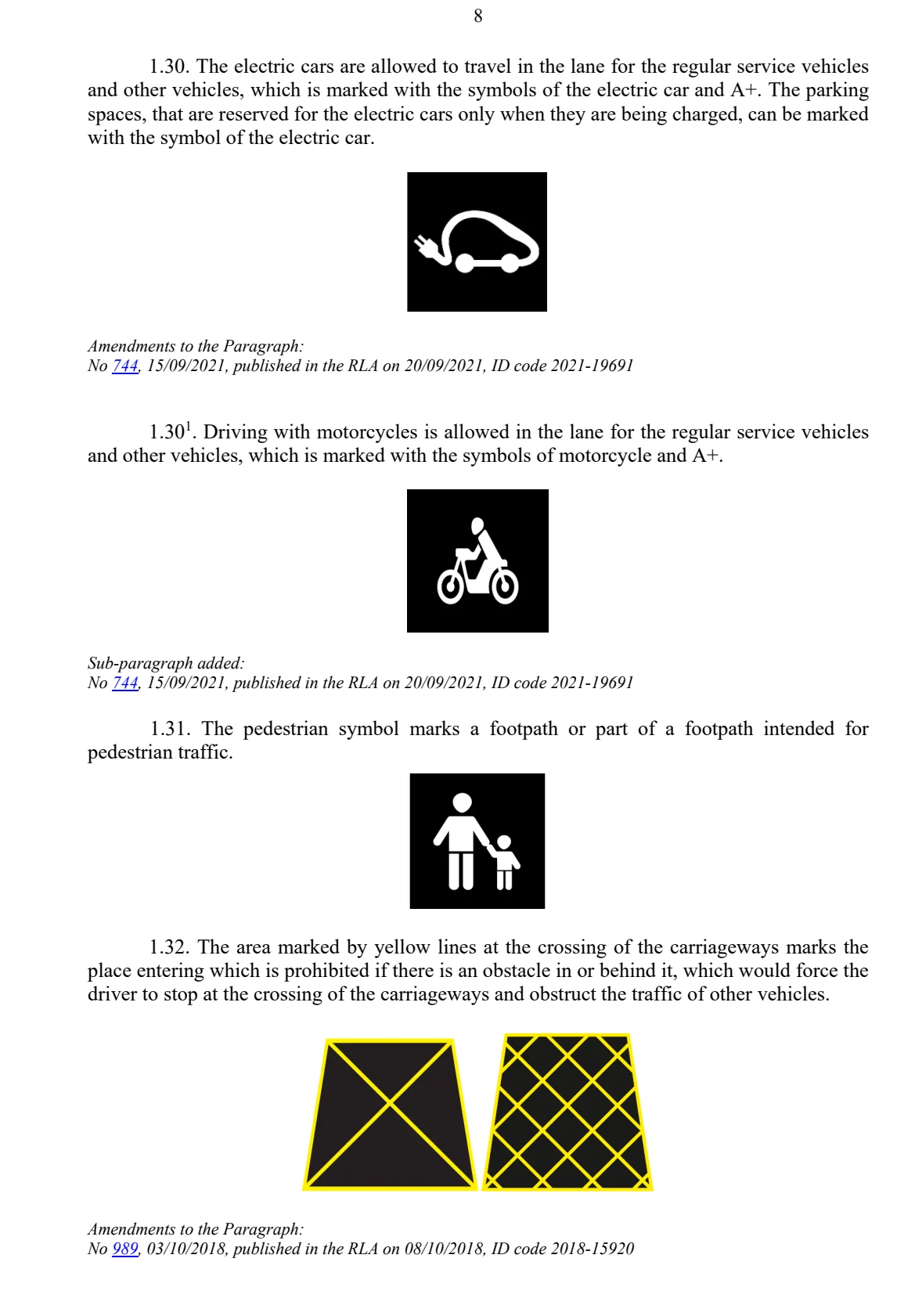
1.30. The electric cars are allowed to travel in the lane for the regular service vehicles
and other vehicles, which is marked with the symbols of the electric car and A+. The parking
spaces, that are reserved for the electric cars only when they are being charged, can be marked
with the symbol of the electric car.
Amendments to the Paragraph:
No 744, 15/09/2021, published in the RLA on 20/09/2021, ID code 2021-19691
1.301. Driving with motorcycles is allowed in the lane for the regular service vehicles
and other vehicles, which is marked with the symbols of motorcycle and A+.
Sub-paragraph added:
No 744, 15/09/2021, published in the RLA on 20/09/2021, ID code 2021-19691
1.31. The pedestrian symbol marks a footpath or part of a footpath intended for
pedestrian traffic.
1.32. The area marked by yellow lines at the crossing of the carriageways marks the
place entering which is prohibited if there is an obstacle in or behind it, which would force the
driver to stop at the crossing of the carriageways and obstruct the traffic of other vehicles.
Amendments to the Paragraph:
No 989, 03/10/2018, published in the RLA on 08/10/2018, ID code 2018-15920
Source page 90
Read the text of this page
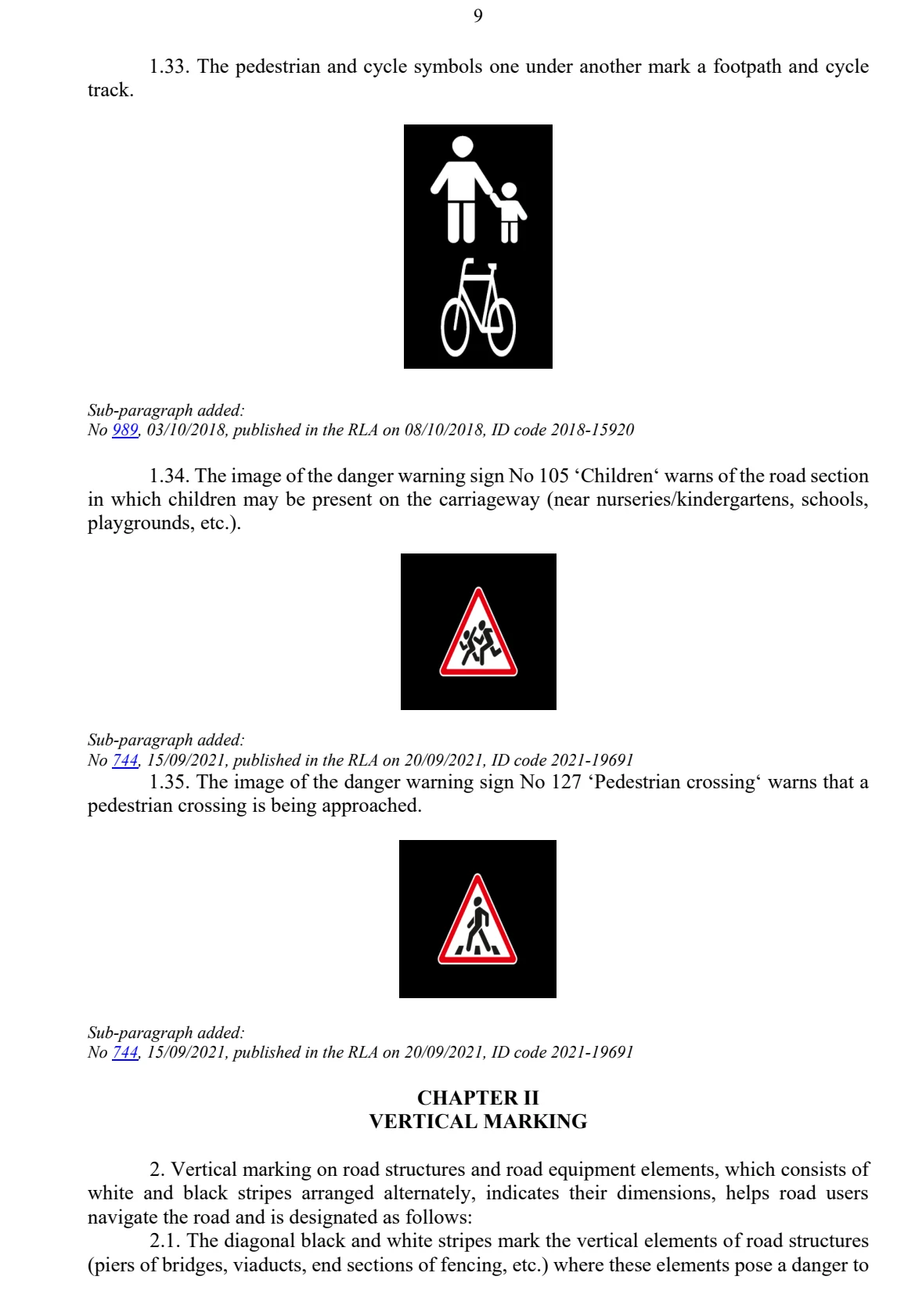
1.33. The pedestrian and cycle symbols one under another mark a footpath and cycle
track.
Sub-paragraph added:
No 989, 03/10/2018, published in the RLA on 08/10/2018, ID code 2018-15920
1.34. The image of the danger warning sign No 105 ‘Children‘ warns of the road section
in which children may be present on the carriageway (near nurseries/kindergartens, schools,
playgrounds, etc.).
Sub-paragraph added:
No 744, 15/09/2021, published in the RLA on 20/09/2021, ID code 2021-19691
1.35. The image of the danger warning sign No 127 ‘Pedestrian crossing‘ warns that a
pedestrian crossing is being approached.
Sub-paragraph added:
No 744, 15/09/2021, published in the RLA on 20/09/2021, ID code 2021-19691
CHAPTER II
VERTICAL MARKING
2. Vertical marking on road structures and road equipment elements, which consists of
white and black stripes arranged alternately, indicates their dimensions, helps road users
navigate the road and is designated as follows:
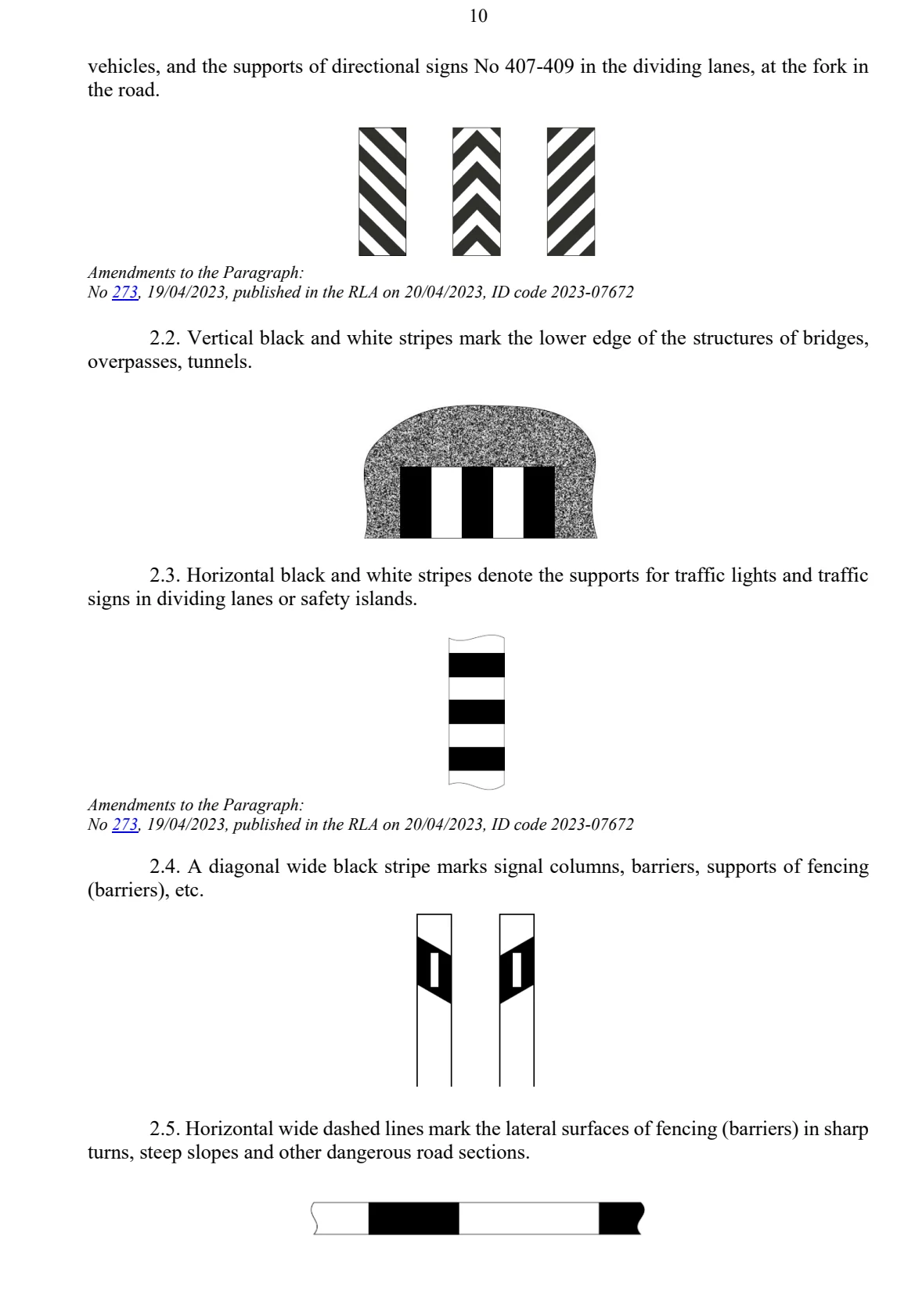
2.1. The diagonal black and white stripes mark the vertical elements of road structures
(piers of bridges, viaducts, end sections of fencing, etc.) where these elements pose a danger to
Source page 91
Read the text of this page
vehicles, and the supports of directional signs No 407-409 in the dividing lanes, at the fork in
the road.
Amendments to the Paragraph:
No 273, 19/04/2023, published in the RLA on 20/04/2023, ID code 2023-07672
2.2. Vertical black and white stripes mark the lower edge of the structures of bridges,
overpasses, tunnels.
2.3. Horizontal black and white stripes denote the supports for traffic lights and traffic
signs in dividing lanes or safety islands.
Amendments to the Paragraph:
No 273, 19/04/2023, published in the RLA on 20/04/2023, ID code 2023-07672
2.4. A diagonal wide black stripe marks signal columns, barriers, supports of fencing
(barriers), etc.
2.5. Horizontal wide dashed lines mark the lateral surfaces of fencing (barriers) in sharp
turns, steep slopes and other dangerous road sections.
Source page 92
Read the text of this page
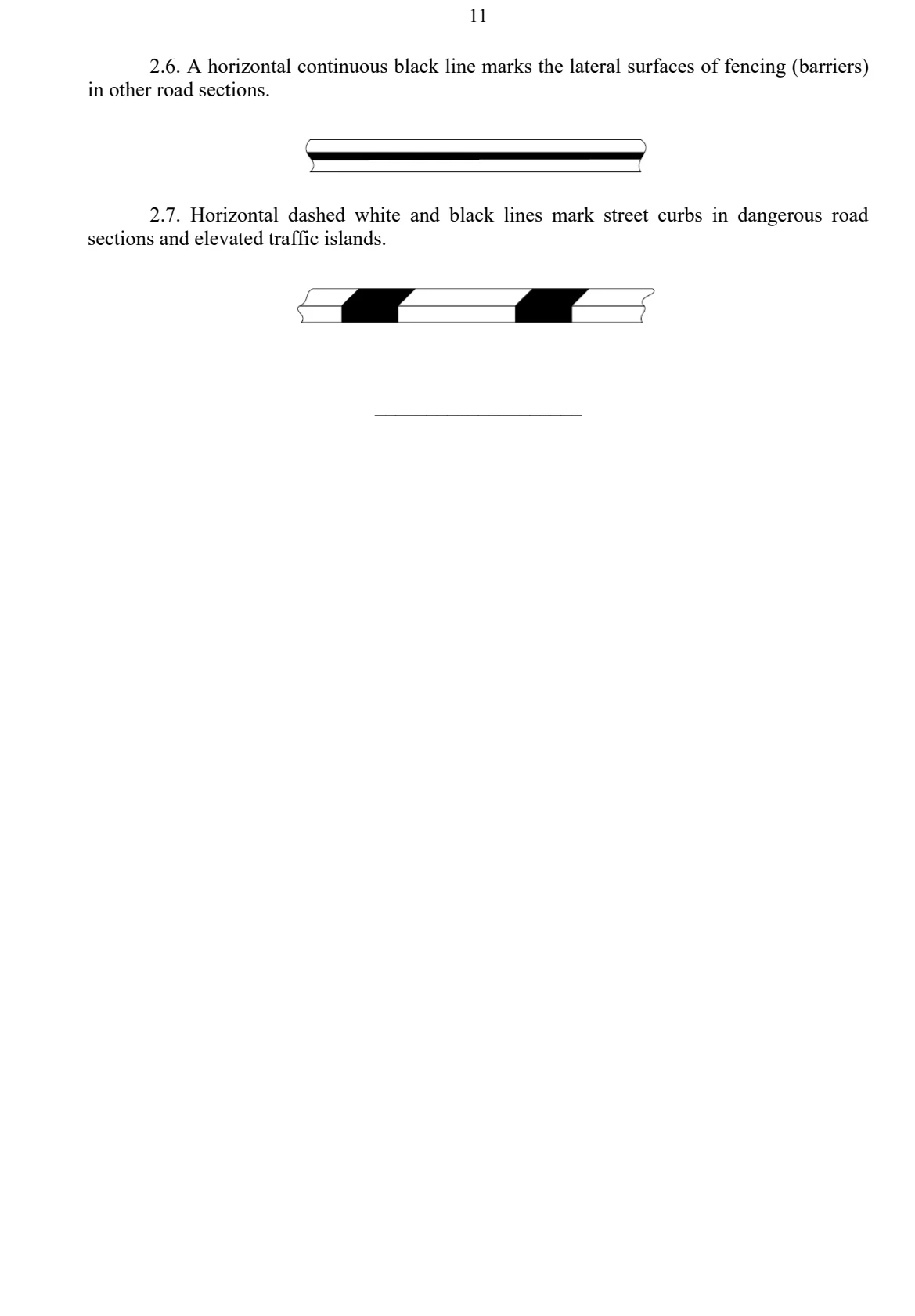
2.6. A horizontal continuous black line marks the lateral surfaces of fencing (barriers)
in other road sections.
2.7. Horizontal dashed white and black lines mark street curbs in dangerous road
sections and elevated traffic islands.
––––––––––––––––––––