Study guide
The Regitra practical exam: preparation and what to expect
In the practical exam, you need to demonstrate that you can safely drive and make independent decisions. Here you will find a clear description of the B category exam process, evaluation explanation, and preparation plan. Tasks applicable to A, C, CE, and D categories and additional tasks for their vehicles.
Short
- Before driving: 3 inspection questions
- Evaluation: KK, SPK and NK – different subjects
- Preparation: Independent safe decisions
Driving errors: learn to recognize risk before driving
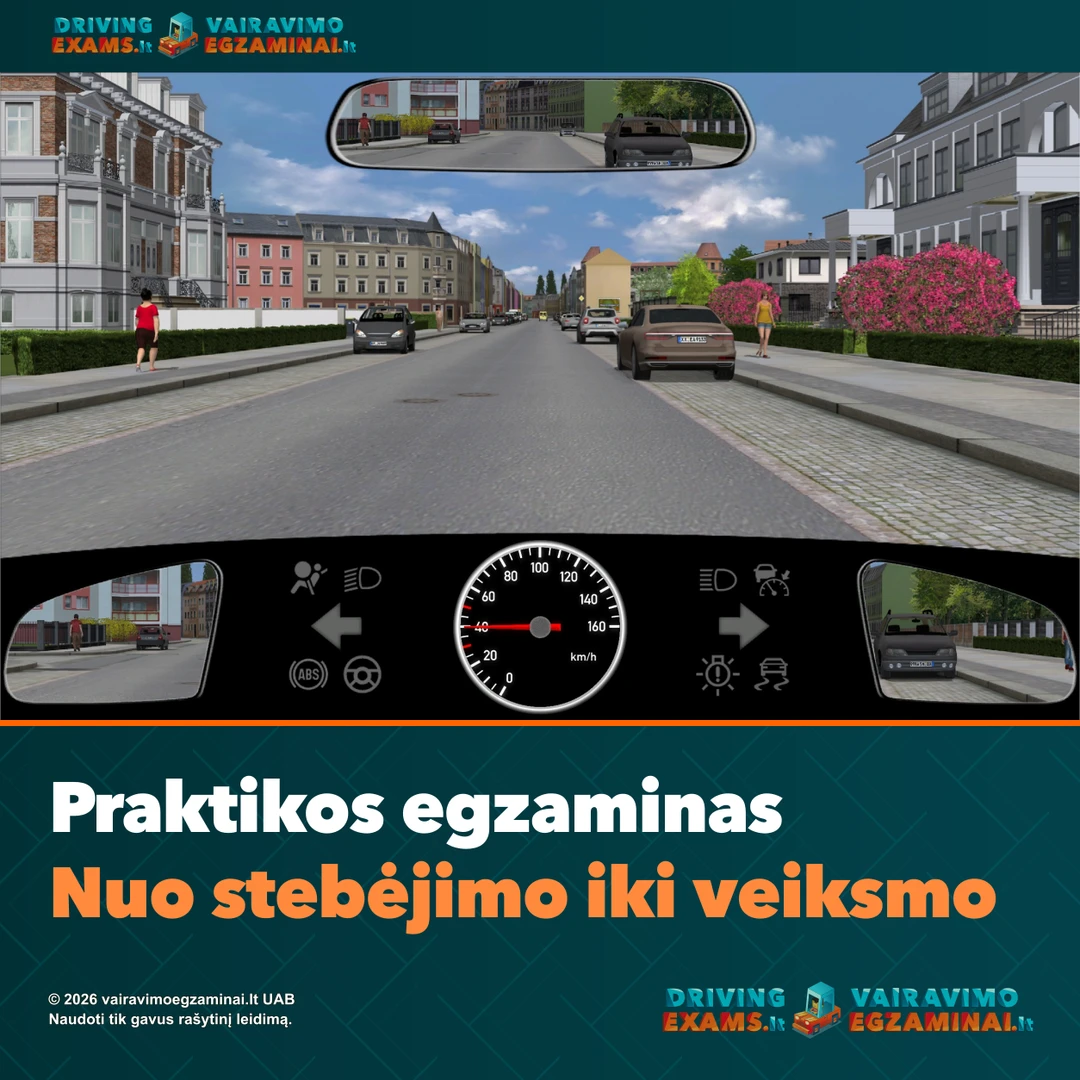
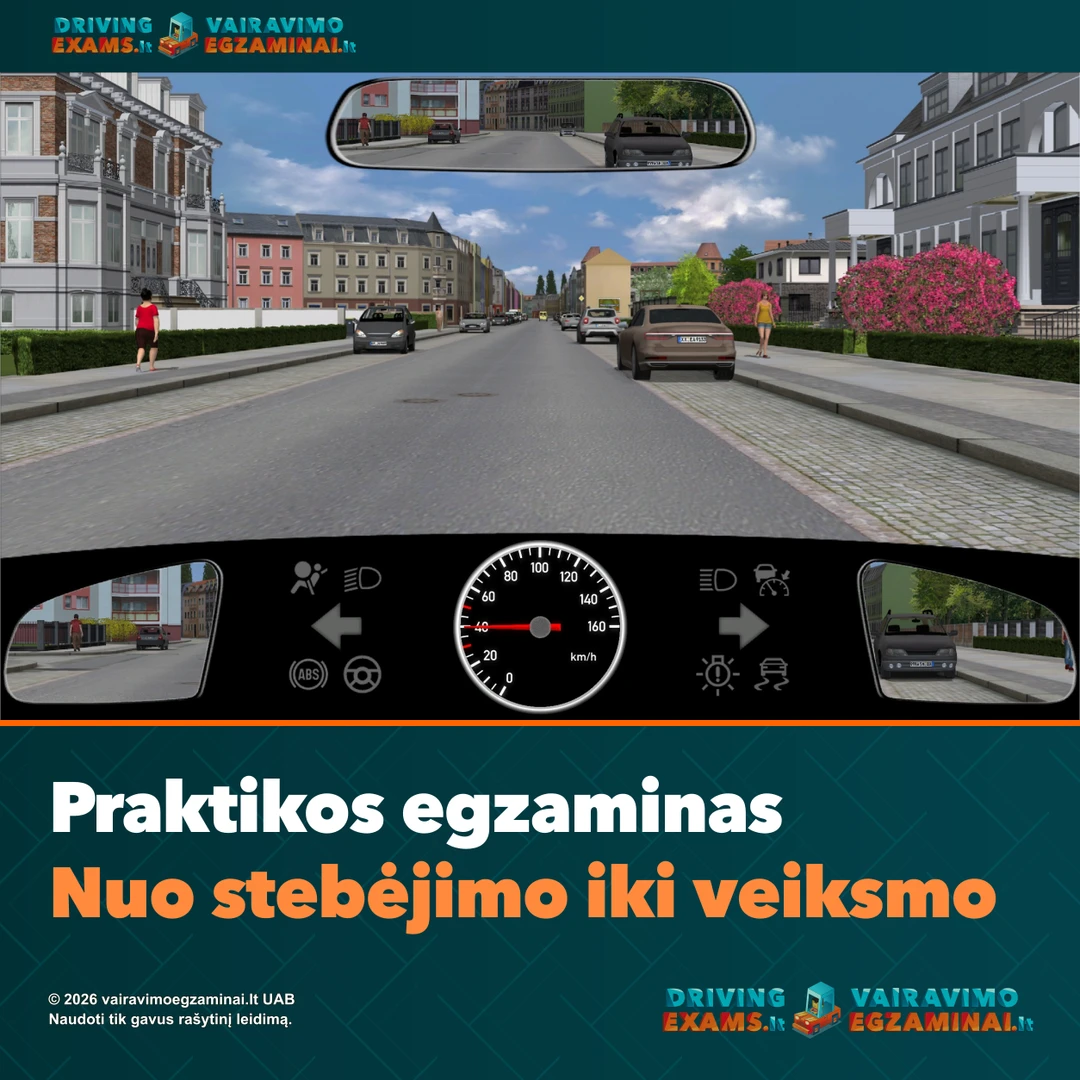
VairavimoEgzaminai.lt in the set „Driving errors: critical and non-critical“ contains a bank of 144 questions. It is intended for considering and discussing situations, and why the chosen action may be unsafe. This is the platform's learning material, not a promise that you will get official practical exam questions or guaranteed evaluation results.
When solving, try to recognize the risk, understand the purpose of observation and explain the reason for the decision. The benefit of learning becomes especially evident when you link a theoretical example with a situation from your practical lesson. Write down what you did not notice, what information you had to evaluate earlier and what question you want to ask the instructor.
How to combine error questions with video and practice?
- Solve the question. Mark and note the answers you chose by guessing.
- Watch the related KET video topic. Unclearness about priority or maneuvering is easier to examine by returning to the basis of the rules.
- Examine the explanation. Identify the risk and plan a safer solution.
- Repeat and discuss while driving. Check understanding after the break, and practice the specific action with the instructor.
A single question result does not replace real driving skills. Related general KET video lessons help understand the logic of the rules; refer to them by topic along with the questions. In the platform, you can choose Lithuanian, English, or Russian language, and check the language of specific material separately.
After driving, select one recurring uncertainty and allocate another learning session to it. This will help distinguish knowledge gaps from difficulties in noticing the situation or performing the action.
Watch the access description or Get 50 free minutes. For it write kokybe@vairavimoegzaminai.lt and mention that you are preparing for practice.
Are you ready for the exam? Check the untraveled kilometers, not the solutions
A good lesson does not necessarily mean you are ready for the exam. Assess how much help is still needed: does the instructor remind you to look in the mirror, choose the gap at the intersection, tell you when to brake? Ask the student to drive a part of the lesson without such hints and discuss specific situations after the lesson.
- Before maneuvering, you yourself notice other road users and assess their movement.
- You choose the lane in advance, following the signs and markings.
- You can explain the choice of speed based on visibility, road surface, and traffic conditions.
- While maneuvering, you control the surroundings, the car's position, and the speed of movement.
- If you make a small mistake, you can calmly continue driving.
If one point still raises doubts, dedicate more attention to it in the last lessons. The goal of learning is the repeated ability to demonstrate it in an unfamiliar street.
What to prepare before the exam day
Check the registered exam category, location, date, and selected vehicle. Make sure the school has sent the completion of training data, and the required grades and theory results are valid. Take a valid ID document to the exam; if the data required is not available in the 'Regitra' system or you have special circumstances, agree in advance on the list of documents. Requirements are set in the official exam conditions and procedures description.
Come with some time to spare, comfortable clothing, and a good sense of self for the lesson. If you need vision correction, make sure you have the necessary equipment. On the last day, it is better to review your preparation and get a good night's sleep rather than trying to learn new maneuvers in a hurry. For the motorcycle exam, separately check the required protective clothing and vehicle conditions.
How does the B category practical exam proceed
At the beginning, you will become familiar with the exam conditions and the car. Allocate time for seating, mirrors, seat belt, and main controls. Ask if you are unsure how a specific car equipment works. Familiarizing yourself with the car helps focus on the road, not searching for an unfamiliar button.
The exam tasks include preparation for safe driving, inspection questions, maneuvering, and driving in traffic. According to the exam procedure B category driving on the road lasts no less than 25 minutes, except for the cases specified in the description. For B category, 10–15 minutes of independent driving is also tested according to navigation or traffic route instructions.
First, understand the examiner's instructions, then assess how to carry them out safely. If you didn't hear, ask for repetition. If you delay choosing a turn, do not try to achieve it with a sudden lane change: a safe decision is more important than trying to get to the desired street at any cost.
Questions before driving: pay to check, not just to say
According to evaluation criteria description three randomly selected questions for the pre-driving check are asked. In the B1 and B category question lists, there are 20 questions about car control, condition and safety. They cover fluids, brakes, tires, lights, signals and other equipment. The exact list of questions is provided in the same description's Appendix 1.
With the instructor, sequentially demonstrate where you will look for the required information, what you will check and how to recognize an unsuitable condition. For example, when learning the tire topic, you should explain both the pressure check and the protector and overall condition assessment. Remembering only numbers is not enough.
The locations of controls can vary in different cars. Therefore, practice recognizing their symbols and purpose. Learn about the coolant fluid question together with the conditions for safe inspection; do not improvise by opening a hot system. First, test all practical actions with an instructor.
Critical, non-critical, and recurring errors – how do they differ?
Non-critical error (NK) shows insufficient skill, but on its own does not create a potentially dangerous situation. Critical error (KK) matches the description of a dangerous or other inappropriate action. Specific recurring error (SPK) – six non-critical errors when performing the same action described in the evaluation description.
According to the valid evaluation description 7–10 points the exam is failed by making one KK, one SPK, or nine or more counted NK in the total result. Therefore, you can have no more than eight counted NK, but there cannot be KK or SPK. The SPK rule does not apply to any six similarly named errors: the actions to be evaluated are exactly those listed in the description.
Do not assess the situation based on just one phrase, for example, 'the engine has died.' It is evaluated what you specifically did and what were the circumstances. After the exam, ask to explain the recorded error according to the report. This will help understand what action needs to be changed, rather than guessing, or just being luckier next time.
What to practice at intersections, at crossings and when changing lanes
Repeat one consistent decision-making process: notice – understand – anticipate – choose – execute. As you approach an intersection, look for not only your traffic light. In advance assess the lanes, signs, pedestrians and the place you can turn into.
When changing lanes, gather information with your glance, signal and check if the gap remains safe. Mirror check is not a ritual: you need to understand how fast the visible vehicle is approaching and whether there might be another road user in the blind spot. At a crossing, anticipate what is blocked by a parked vehicle, a signboard or plants.
Discuss with your instructor the situation where you cannot safely carry out the planned maneuver. The payment for refusing an unsafe decision is a valuable driving skill. Resolve theoretical doubts about priority or signs KET explanation guideThen check how you apply this principle on the road.
Maneuvering and parking: the environment is more important than a single reference point.
Develop your parking skills in different locations. The rule 'turn the wheel straight at that pole' will not work if the car's dimensions, space width, or starting position change. Understand where the car's rear, front corners, and wheels are moving.
Before starting, assess pedestrians, other vehicles, and space boundaries. Drive at a speed that allows you to stop immediately upon noticing an obstacle. If necessary, safely stop, reassess the situation, and only then continue. After the maneuver, check not only whether the car fits, but also whether you did not cross the line, left a proper position, and safely completed the action.
Specific exam maneuvers and their execution conditions should be coordinated with the instructor according to the official annex 2 description. Tasks and assessed situations vary by category.
Final lesson plan: three checks instead of route talking
- Self-reliance check. Drive in an unfamiliar direction, and allow the instructor to intervene when safety requires it. After the lesson, write down three situations in which help was still needed.
- Improving weak points. Turn each difficulty into a specific task: earlier notice of the lane end, more accurately assess the gap, or more consistently scan the surroundings. Practice in various locations.
- Overall assessment. Do the preparation, inspection questions, maneuvers, and driving again with less instructor explanations. Assess whether the skill remains throughout the entire drive.
For each mistake, write two sentences: 'What did I not notice?' and 'What will I do earlier next time?' Such a note helps more than a general evaluation 'I'm driving badly'. Knowledge of the exam route cannot replace the ability to read traffic situations.
After the exam: convert the evaluation into a further plan.
Listen to the result and explanation of specific situations. If you failed, separate two tasks: understand the report and learn to perform the action differently. Discuss with the instructor where the solution started too late and what information was missing.
Allocate the next learning time to a specific reason. For example, a poor lane choice may start not at the intersection, but earlier, without noticing the direction sign. If you need to revise the theory, repeat it with KET bilietais and video lessons. The exam is organized and evaluated by „Regitra“; on this page we provide preparation guidelines, while individual exam conditions can be checked in the official information.
Other practical lessons tasks
Mark it for yourself. This list helps plan your learning.
- With the instructor I listed the most difficult action.
- I checked what I can do without reminders.
- I repeated the questions before driving to the car.
- I practiced the maneuver in various places.
- After driving, I wrote down what I will notice earlier next time.
Frequently asked questions
How many non-critical errors can be made in the practical exam?
You can make no more than eight errors in total, including NK, if there are no KK or SPK. Nine NK already mean failing the exam. Exact calculation and SPK conditions are set Evaluation description.
How many questions are asked before the practical exam?
According to the evaluation description, three random questions are asked. In the B1 and B category lists there are 20 questions. Study and explain, and demonstrate the required test.
Is one engine failure always a sign of a failed exam?
No. The situation and consequences of the action are evaluated. The description separately sets the criteria for non-critical, recurring and critical errors, so it is not possible to determine the final result solely based on the fact that the engine has failed.
Is it worth memorizing specific exam routes?
It is useful to get to know various intersections and signs, but base your preparation on safe driving in different areas. In the exam, it is important to independently understand the situation at that moment.
Choose the next step
Use the answer found in this guide: plan one specific action for today.
Where to continue?
KET tickets and video lessons → Traffic rules with explanations → „Regitra“ theory exam → B category →
Sources and information check
Source verification: 2026-10-15. Check changing exam conditions before registering.
- Description of criteria and methods for assessing driving skills and abilities of motor vehicle drivers, summary from 2025-05-20
Checked on 2026-10-15. - Description of conditions and procedures for motor vehicle driver examinations, summary from 2026-02-09
Checked on 2026-10-15. - Information about the practical exam at Regitra
Checked on 2026-10-15.