Study guide
Traffic rules: how to apply them on the road
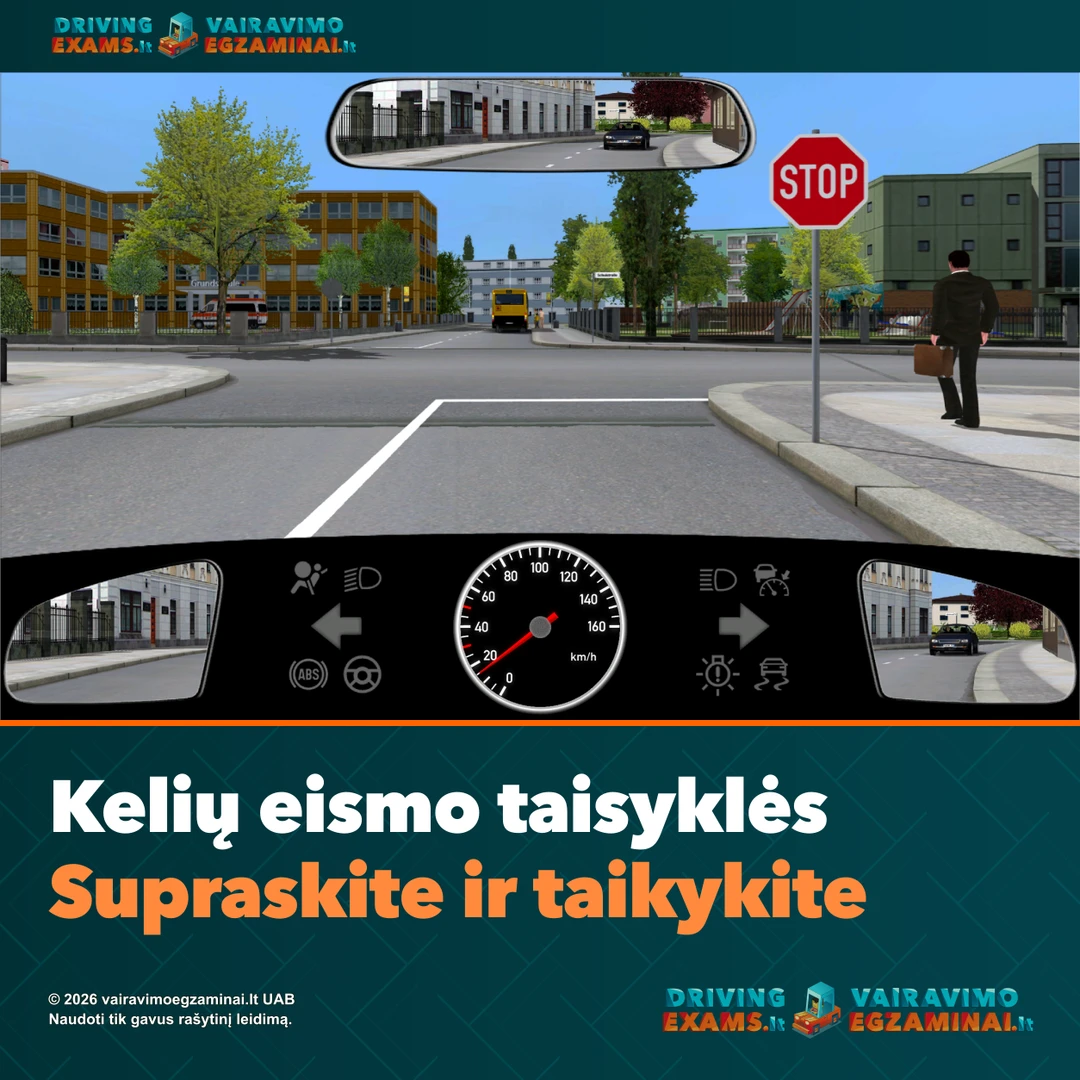
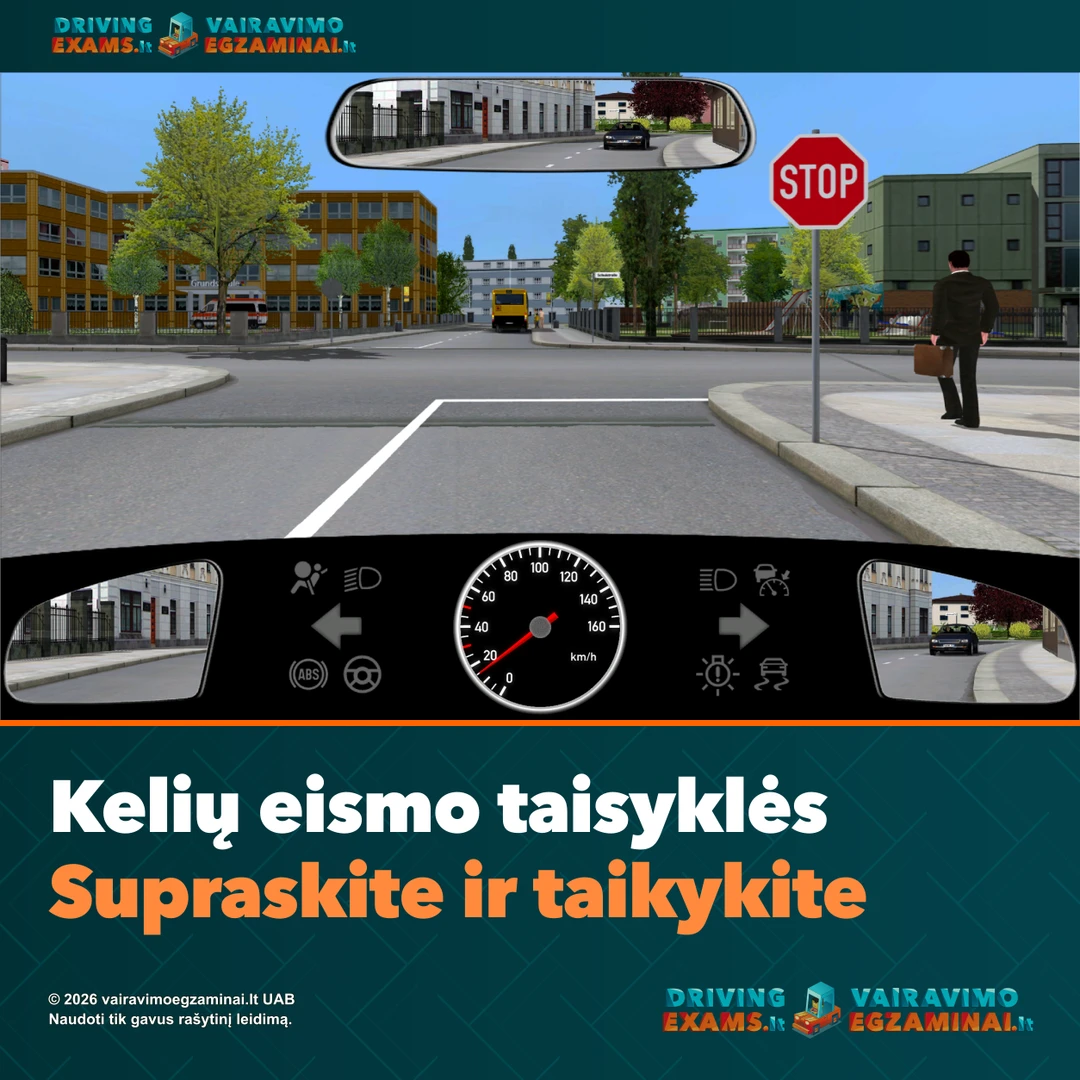
KET is easier to understand when you link each requirement to a specific action: what to notice, whom to give way to, and when you can drive. This guide will help organize the learning topics, clarify common doubts, and move from reading rules to solving traffic situations.
Short
- Legal act: Official KET summary
- Learning content: Explanations of 8 topics
- Objective: Base your decision on your own judgment
Official KET text and learning explanations – where to find what
You can find the official Road Traffic Rules compilation here in the e-Seimas legal acts system. The KET compilation valid during the 2026 October 15th test – from January 1st, 2026 When opening the source, always check the compilation validity date: an old article or search result may lead to an earlier edition.
On this page we provide learning explanations and examples. They help understand the application of the rules; the entire official text with appendices remains in the primary source. If the question involves a crucial exception or condition, read the relevant KET paragraph and adjacent provisions. One of the context-extracted lines may not reveal the entire answer.
Starting to learn, there is no need to memorize the entire document at once. First, create a clear basis, then add the conditions and exceptions of individual situations.
Select the topic where questions are currently arising
- Road signs and signposting
- Traffic lights and traffic controller
- Crossroads and right of way
- Maneuvering and traffic lanes
- Speed, distance and visibility
- Pedestrians and cyclists
- Stopping and parking
- Roundabouts, crossings and other special places
Do not study the topics based on how many questions you have already answered. Choose the place where you still can give an answer. If you do not know where to start, first find out the signs, traffic regulation and right of way, and then move on to maneuvers.
1. Road signs and signposting: find out to whom the requirement applies
Sign recognition – just the first step. Then decide for which type of vehicle, lane, side of the road or section it applies. An additional table can change how you should understand the sign above it.
Example. You see a parking sign with an additional table. Before deciding whether you can leave the car, evaluate the table's conditions and other requirements that apply in that place. One symbol 'P' does not answer all questions.
Color, line shape, and position have meaning. If the requirements of a road sign and signposting differ, KET 8 points indicate to follow the road sign. Check the exact meanings of signs and lines In KET 1 and 3 annexes.
2. Traffic lights and controller: to whom is the signal directed?
Answer two questions when approaching a traffic light: is this signal directed to my movement and under what conditions can I proceed? Separate the standard signal, the arrow in the additional section, and the table with the green arrow – their operating conditions are different.
Example. The green light has turned on, but the intersection is still being crossed by a vehicle that legally entered earlier. The allowed signal does not cancel the obligation to give way. This is specified in KET 161 point.
If traffic is controlled by a controller, first understand his signal regarding you. His instructions have priority over traffic lights, signs and signposting according to KET 8 point. When learning, it is worth reviewing the same position from different approaches.
3. Intersections and priority: first determine the situation type
Do not start from the car's color or its position in the picture. Determine whether the intersection is regulated, which roads cross, where each participant is going, and whether their trajectories intersect.
Example. In an unregulated equal-road intersection, the car is approaching from your right and its trajectory crosses your movement. According to KET 155, you give way to it. However, if you determine that your road is the main one, this single sign is no longer sufficient for the same answer.
Check the order of movement consistently, comparing the actions of traffic participants in pairs. Priority rules are provided In KET Chapter XVIII. If changing one sign changes the answer, explain to yourself which condition caused that.
4. Maneuvering and traffic lanes: turn signal does not grant priority
Before changing the direction of movement, you must assess safety and other traffic participants. While learning, it is useful to distinguish three actions: preparation for maneuver, indication of intention, and the maneuver itself.
Example. You want to change lanes into the adjacent lane, which is already being used by another car in the same direction. Turning signal activation does not obligate you to free up space for it. According to KET 104 point, when overtaking, you give way to the other vehicle.
Assess the direction of the lanes, solid lines, and remaining distance. A missed turn can be resolved by choosing another safe direction. Read the requirements for maneuvering in KET XIII chapter, and practice observation and vehicle position selection with an instructor.
5. Speed and distance: the allowed number is not a safe choice
Learn to assess speed together with visibility, weather, road conditions, and surrounding participants. According to KET 127 point, you must consider these circumstances and choose a speed so that you can stop before an anticipated obstacle.
Example. On the road, it is allowed to drive at the set speed, but a car in front is blocking the way. Assess where you would see the pedestrian and how much space would remain to stop. One statement „I did not exceed the speed limit“ does not prove that you have assessed the situation properly.
When solving the question, note whether it refers to the maximum allowed speed or the safe speed under specific conditions. Check the numbers and their application conditions in KET XV chapter.
6. Pedestrians and cyclists: look for a person behind the symbol
Assess where the person is moving, which direction they are looking, what might be obstructing the environment, and whether your path will cross theirs. Rules differentiate between different locations: crossroads, pedestrian crossing, bicycle crossing, and exiting from the area adjacent to the road.
Example. You are driving backwards from the parking spot, and a pedestrian is walking behind the car. KET 27 point establishes the obligation to give way to pedestrians in all cases of reversing. An empty image in one of the mirrors does not mean that the entire environment is free.
In this topic, precise conditions are especially important. Study according to KET V–VIII chapter and crossing requirements, and not just a short shout about right of way.
7. Stopping and parking: evaluate the entire area
Before choosing a spot, distinguish whether the situation refers to stopping, parking, or mandatory stopping. Then check the signs, markings, distances, and whether your car might obstruct visibility or crossing.
Example. By turning on the hazard lights, you want to temporarily leave the car in a prohibited area. Signalization does not replace the requirements applicable at that location. Evaluate only the real reason for stopping and the conditions specified in KET.
According to the picture, learn to identify a crossing, intersection, stopping place, and the boundaries of the traffic lane. Do not answer distances approximately: read the exact dimensions and their exceptions. KET Chapter XVII.
8. Roundabouts and railway crossings: the decision is determined by specific regulations.
At a roundabout intersection, evaluate the signs before entering, the direction of the lanes, and the possibility of exiting. One round shape of the intersection does not tell the entire traffic order. It is necessary to distinguish right of way from changing lanes and the requirements of the chosen lane.
Example. There is a sign 'Give Way' at the entrance to the roundabout. Its requirement is evaluated before entering, and while driving and changing lanes, additional maneuvering rules are applied. One successful entry does not mean that you can exit from any lane.
Learn railway crossings as a separate topic: signals, barriers, and the possibility to finish the crossing are safety issues. Exact requirements are provided KET Chapter XIX.
How to turn a rule into a clear answer
- Read the entire question. Notice the words 'must', 'allowed', 'prohibited' and conditions that change the answer.
- Identify the decisive factor. This can be a signal, sign, direction of movement or type of road.
- Find the rule and explain the decision in your own words. One correct letter is not enough.
- Change one condition. Ask yourself if the answer would remain the same without the sign or if the car were turning in the opposite direction.
- Review the topic later. Check if you remember the principle and apply it in a new image.
KET theory tests and video lessons Use together with rule reading. If the test reveals a gap, go back to the topic explanation. If you are preparing for the first exam, get to know and understand Conduct of the “Regitration” theoretical examination.
Frequently asked questions
Where to find the latest official KET text?
The official summary is provided in the e-Seimas system. Check the stated edition validity date. As of the 15th of October 2026, the valid summary was from the 1st of January 2026.
Is the entire official KET text presented on this page?
Here you will find a learning guide and examples of applying the rules. The entire official text, signs, and sign annexes can be found in the link to the legal act.
Is it enough to solve the tests without reading the rules?
Tests help identify gaps, but remembering answers may mislead you when situations change. Read the related rule and learn to explain why you chose the answer.
Is this guide suitable for A, B, C, CE, and D categories?
General traffic principles are relevant for all these categories. For categories with specific dimensions, control, cargo, passenger, and other special requirements, additional training is required.
Choose the next step
Use the answer found in this guide: plan one specific action for today.
Learn KET with tests and video lessons
Where to continue?
KET exams → Free KET test → „Regitra“ theory exam → Regitro Practice Exam →
Sources and information check
Source verification: 2026-10-15. Check changing exam conditions before registering.
- Road traffic rules, summary from 2026-01-01
Checked on 2026-10-15. - Official KET edition PDF
Checked on 2026-10-15. - KET official edition search entry from the e-Seimas official list
Checked on 2026-10-15.