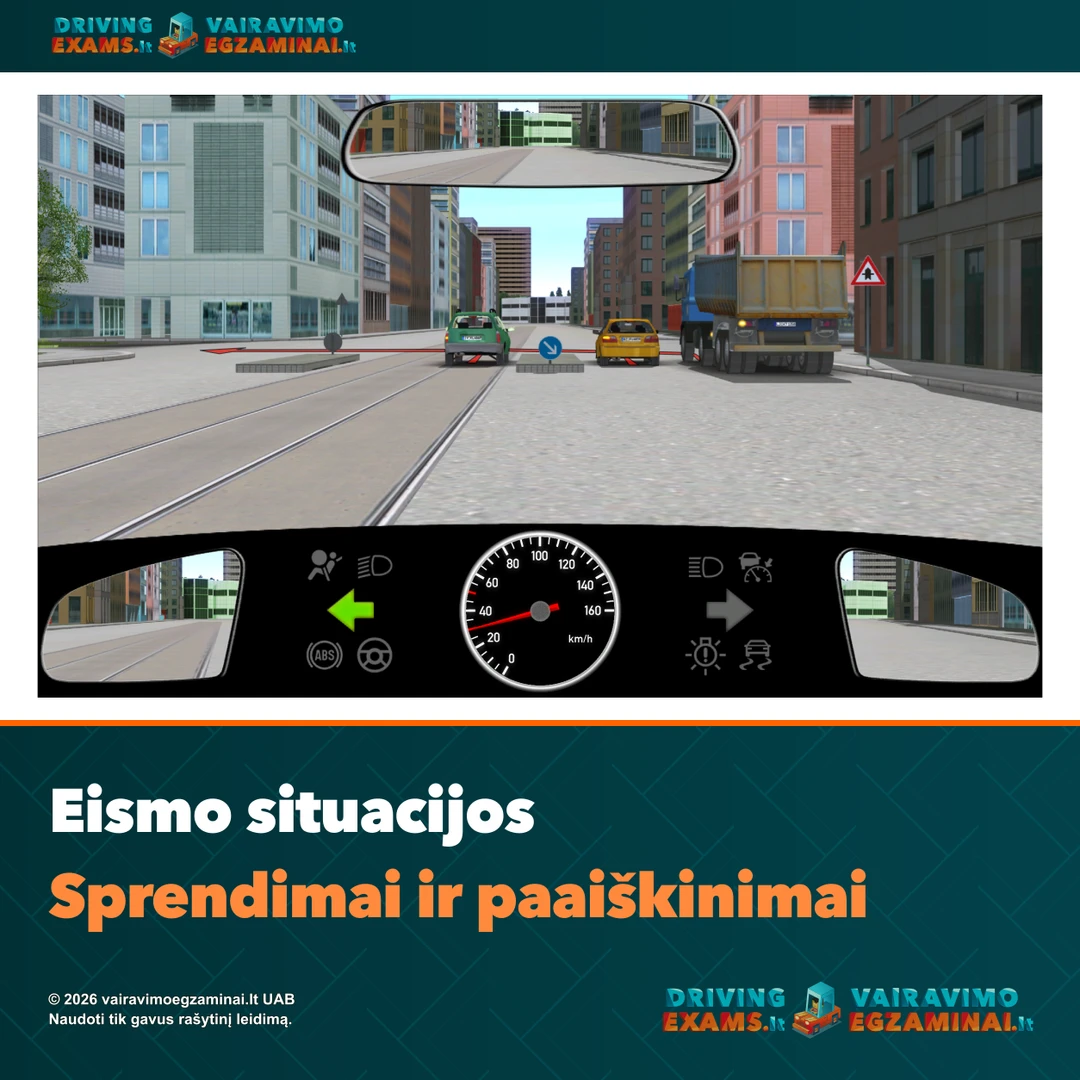
Tests, lessons and explanations
Traffic scenarios: practise spotting hazards and anticipating what happens next
See the sign – that's the beginning. Analyze traffic situations, video questions and safe driving topics to understand what is important to notice, where to focus your attention and how to justify your actions.
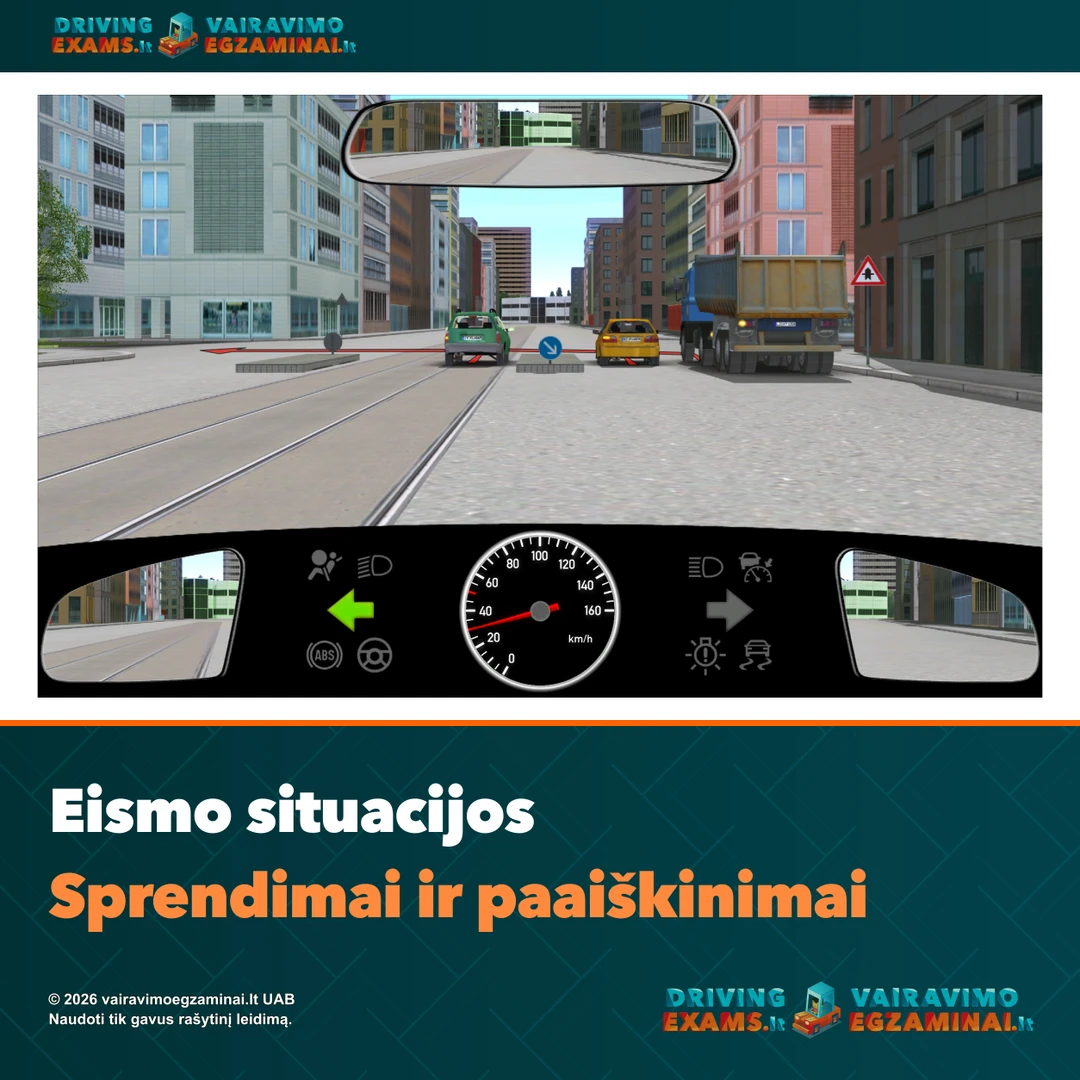
Why is traffic situation analysis useful?
This learning area is suitable for beginners, preparing for the theory or practical exam, and for drivers who want to check their decisions. It is especially useful when you remember the rules separately, but in one illustration it is difficult to assess all the signs, lanes and other traffic participants.
Here it is worth learning not only the answer. It is important to understand what you saw, which rule is related to the question and where the wrong assumption could have arisen. Evaluate each situation as a small problem-solving task.
Video questions and safe driving topics
VairavimoEgzaminai.lt You will find programs „KET real driver video questions“ and „A B C CE D Safe“. They help to look at the rules through the driver's decisions. Select specific topics by logging into the learning environment and considering your preparation goals.
- Video questions allow examining the traffic environment from the driver's perspective and observing how the situation develops.
- Safe driving topics focus attention on risk awareness and the consequences of decisions.
Examine the situation more than just one answer option: find the significant context for the question and explain why it changes your decision.
Volume of video questions and safe driving sets
You can choose situations to examine 176 questions set „KET real driver video questions“ or 324 questions set of safe and economical driving and situations. Both sets include a 30-question practice test, which is allocated 60 minutes.
These are two different sets of questions; they are not combined into one unique task count. Video questions are tasks with a situation recording, therefore 176 questions are not 176 separate theory lessons. Consider the answer's reason with the question's explanation, and repeat the related rules' basis in KET topic lessons.
These test lists are available in Lithuanian, English, and Russian learning environments. Choose the format of video questions and general theory lessons according to what you want to learn.
What are we aiming for while learning?
We want you to be able to explain the solution, rather than recognize a previously seen image. To do this, distinguish fact from assumption: a visible turn signal is information, but another driver's real intention is not guaranteed. Similarly, an unobstructed road part does not answer what may appear behind the obstacle.
While learning, develop attention, rule application, and the ability to search for possible problems in advance. Try to formulate your answer in one clear sentence: 'I choose this action because I see these circumstances.' If the sentence is not clear, it is worth returning to the explanation.
Five steps when examining a situation
- Read the task. Determine whether the question is about right of way, allowed action, danger, or driver's behavior.
- Take a look around. Find your lane, signs, signals and other road participants.
- Separate what you see from what you assume. Do not add invisible signs or other people's intentions.
- Choose and justify. Before opening the explanation, say why the other options are not suitable for you.
- Compare the arguments. Check not only the marked letter, but also the sequence of your reasoning.
How to work with video questions?
During the first review, try to understand the whole situation, and then focus on the specific question. If the review tool allows, go back to the place where the important circumstances appeared. Note down what you noticed too late: the pedestrian, the sign, the lane change or limited visibility.
Discuss the reason for the decision using the question explanation. If the rule basis is missing, go to the corresponding KET topic and its lesson. The video helps to see the rule in context, while the text explanation precisely states its meaning.
Short practice session
Imagine a street where a large car is parked in front and blocks part of the sidewalk. Instead of immediately choosing an answer, list what you do not see right now and where another road user could appear. Then consider what additional information would be needed to make a decision.
The purpose of this exercise is to notice the unknown, not to create a rule that is not in the question. Similarly, examine overtaking: LTSA emphasizes visibility, distance, and the possibility of safely returning to your lane. More – LTSA explanation on overtaking and maneuvering.
How to connect tests with driving lessons?
Choose one of the more difficult situations for you and take the question to your lesson: „Where should I look earlier here?“ or „What information was missing?“ This question is easier to discuss with your instructor than the general „I’m not doing well at intersections.“
Use the principles examined in tests for preparation for the practical exam, and memorize the exact formulations On the KET learning page. Online analysis complements practical training with an instructor.
Check your preparation at your own pace
For one training session, select a small group of exercises. After each mistake, briefly write down its cause: unnoticed sign, misunderstood question, or incorrectly applied rule. Next time, go back to the cause and check if you can now explain it.
Select your learning access In the store. Due to Get 50 free minutes Write to us kokybe@vairavimoegzaminai.lt and specify which program you want to try.
Frequently asked questions
How does a video question differ from a regular image?
In a video recording, you can observe the situation's progression and changes in circumstances. An image allows you to calmly examine one moment. Both formats are useful when you review the answer and its cause after.
Is this material only for B category?
In the program list, there are also general A, B, C, CE, and D category topics on safe driving. Select the material according to your learning goal and the specific content of the task.
What to do if I remember the answer but don't understand the situation?
Hide the answer options and explain aloud which facts you see and which rule you apply. Then compare your reasoning with the explanation and review the related topic.
If you pass these tests, do you still need practical lessons?
Situation analysis is part of preparation. Controlling the vehicle, observing the environment, and performing actions need to be learned practically, according to the applicable training schedule.
Try the learning platform
For 50 minutes of free access, write kokybe@vairavimoegzaminai.lt and specify the desired learning area. Access is granted by contacting.
Where to continue learning?
- Practical exam and error understanding
- Learning of traffic rules
- Get 50 free minutes
- Training access plans
Sources and information check
Content prepared according to the following sources. Verification date: 2026-10-16.
- LTSA: overtaking and maneuvering (checked on 2026-10-16)
- VairavimoEgzaminai.lt test program cards (checked on 2026-10-16)